How to find the perfect entry on meme coins without chasing the pump
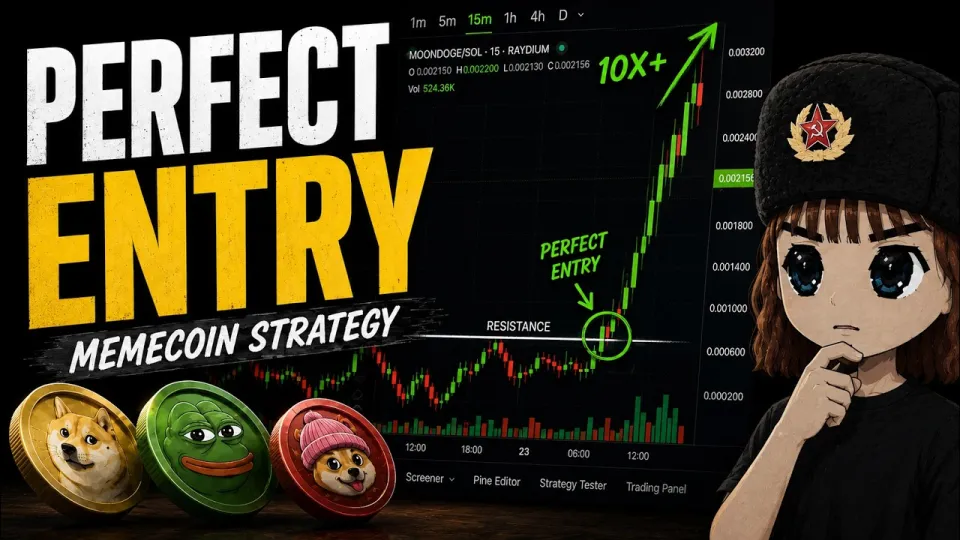
Video: How I Find the PERFECT Entry on Memecoins 📈 (Full Strategy)
Want articles like this for your own video to promote it on YouTube and Google? Order them through the Telegram bot @sat_sit_bot. Articles with your video embedded are written and posted by the bot itself — on popular topical sites (no ads). Try it free: 50 articles on us.
Key takeaways
- Most meme coin losses come from timing the entry, not from picking the wrong ticker
- A valid setup needs structure plus confirmation: higher lows, volume expansion and a clean reclaim
- Buying a pullback into support beats buying a vertical green candle every time
- A fixed invalidation level and pre-planned profit-taking define the real risk-to-reward
- Skipping a trade that fails the checklist is a position, not a missed opportunity
A meme coin entry is the price level where you buy after the chart has already confirmed demand, not the moment a green candle catches your eye. The practical answer: wait for structure (higher lows or a reclaim of a broken level), confirm it with volume and momentum, size the position from a fixed invalidation point, and plan your exits before you click buy. The full breakdown of this process comes from the starwifpump video "How I Find the PERFECT Entry on Memecoins", and the team behind it also shares tools and early access through the Plasma Telegram channel.
Meme coins are the most timing-sensitive corner of crypto. A token can be up 400% on the day and still be a terrible buy at the top of a one-minute candle, and the same token can be a reasonable risk an hour later on a retest. That asymmetry is why entry work matters more here than in almost any other market.
Why meme coin entries fail more often than coin selection
Most meme coin traders do not lose because they chose the wrong token; they lose because they entered at the wrong moment. Narratives, tickers and communities get all the attention, but the difference between a 2R trade and a 40% drawdown is usually a few minutes of patience and one support level.
The mechanics are simple. Meme coins have thin order books, fast narratives and reflexive price action: a single wallet or a burst of social attention can move price 30% in a minute, and liquidity disappears just as quickly on the way down. In that environment, chasing a vertical candle means your stop has to sit far below the entry, which destroys the risk-to-reward before the trade even starts. Entering on a controlled pullback lets you place the invalidation close to price, so a normal amount of noise does not stop you out.
There is also a behavioural trap. FOMO makes traders buy the most visible candle, which is by definition the one where the most people have already bought. A repeatable entry process replaces that impulse with a checklist: structure, confirmation, level, size, exit.
The chart analysis to run before you enter any meme coin
Before looking for an entry, build a picture of what the chart is doing: trend, key levels, volume behaviour and liquidity. This is the pre-trade read that decides whether a setup is even allowed to exist.
- Timeframe hierarchy. Use a higher timeframe (15m or 1h) for direction and a lower one (1m or 5m) for execution. If the higher timeframe is making lower highs, a long entry needs to be much better than usual.
- Structure. Mark the last swing high, the last swing low and any level where price stalled or reversed with volume. Those are your reference points, not arbitrary round numbers.
- Volume profile. Healthy moves expand volume on the push and contract on the pullback. A rally on fading volume is a warning, not a signal.
- Liquidity and holders. Check pool depth, holder distribution and whether a few wallets control supply. A beautiful chart on a token with a shallow pool is a trap.
- Catalyst timing. Know whether the move is driven by a listing, a social push or nothing at all. Entries taken into a known catalyst have different risk than entries taken into silence.
The exact setups worth waiting for
High-quality meme coin entries fall into a small number of repeatable patterns, and the best traders spend most of their time waiting for them instead of forcing trades.
- Breakout and reclaim. Price breaks a resistance level, then returns to it and holds. The old resistance becomes support, and the entry is the reclaim candle with volume behind it.
- Higher-low continuation. After an impulse, price pulls back but prints a higher low above the previous one. Entry goes on the first strong close back in the direction of the trend.
- Base breakout after consolidation. A long sideways range with shrinking volume resolves upward. Entries are taken on the breakout close or on the first retest of the range high.
- Capitulation reversal. A violent flush into a known support with a volume spike, followed by a strong reclaim of that level. This is the highest-risk setup and needs the tightest stop.
What these have in common is confirmation. In every case the chart has already shown that buyers are defending a specific price, which is what separates a setup from a guess.
How to use pullbacks and support to improve your entry price
A pullback entry is the single biggest improvement most meme coin traders can make, because it converts a bad risk-to-reward into a workable one. Instead of buying the extension, you wait for price to come back to a level where you can define exactly what would prove you wrong.
The process: identify the level (previous breakout, swing low, or the base of the last impulse), wait for price to reach it, and require a reaction — a wick rejection, an engulfing close, or a bounce with rising volume. If price slices through the level and closes below it, there is no trade. This is also where patience pays: many of the best entries never fill because the token keeps running, and that is an acceptable outcome. Missing a move costs nothing; a badly placed entry costs capital.
Position sizing follows from the level. If your invalidation sits 8% below entry, your size is set by that 8%, not by how confident you feel. Traders who size first and find a stop second are the ones who get liquidated by normal volatility.
Red flags that mean skip the trade
A no-trade signal is as valuable as an entry signal, and meme coin charts produce plenty of them. Skip the setup when the move is a vertical candle with no consolidation, when volume is falling as price rises, when the token is already up several hundred percent with no base, or when liquidity is so thin that your own order moves the price.
Other warnings: a chart that has been pumped and dumped repeatedly with the same wallet patterns, a community that appeared hours ago, and any setup where you cannot name the exact price that invalidates your idea. If you cannot state the invalidation level in one sentence, you do not have a trade — you have a hope.
Planning risk, exits and profit-taking before you buy
Every meme coin trade should be fully planned before entry: invalidation, first target, second target and the conditions under which you exit regardless of price. A common structure is to take partial profit at the first resistance, move the stop to breakeven, and let a runner go only while the higher-timeframe structure holds.
Risk per trade should be a fixed small percentage of the account, because meme coin volatility can gap through stops. Predefine the maximum loss in currency terms, not in percent of a chart, and never add to a losing position on the theory that the token is "cheap now". Exits are part of the entry plan — a trade without a written exit is an unfinished trade.
Common questions from newer meme coin traders
Beginners tend to ask the same things: which chain is best, which trackers to use, how to catch tweets before a pump, and how much capital is realistic to start with. The honest answers are unglamorous. Chain choice matters less than liquidity and execution quality, and the same entry logic applies on Solana, Base or any other ecosystem — structure and volume behave similarly everywhere. Trackers and social tools help you find candidates faster, but they do not replace chart confirmation, and no filter set removes the need to check the level yourself. On capital: a small account trading a disciplined process beats a large account trading on impulse, and anyone who has already lost money should treat a return to meme coins as a test of process, not a race to recover losses.
Useful links
- Plasma Telegram — early access, tools and setup help
- starwifpump Discord community
- Padre terminal access
- Solpump
- starwifpump on X
Bottom line
A meme coin entry is a process, not a prediction: read the structure, demand confirmation, buy the pullback into a defined level, and size the position from the invalidation point. The traders who survive this market are the ones who skip most setups and execute a few with a written plan for risk and profit-taking. The starwifpump breakdown of this strategy is a useful starting point, and the same channel's Plasma Telegram is where the tooling and early access discussed around the video live. Treat every entry as a testable decision rather than a bet, and the results become repeatable instead of lucky.
Questions & answers
What is the best entry point for a meme coin?
The best entry is a confirmed level, not a candle: a breakout that gets reclaimed, a higher low during a pullback, or a base that resolves upward with volume. The entry only becomes valid once the chart shows buyers defending that price, which lets you place a tight invalidation and keep the risk-to-reward reasonable.
How do I avoid FOMO when a meme coin is already pumping?
Accept in advance that you will miss most vertical moves and that missing them costs nothing. Write down the level you would actually buy and refuse to enter above it; if price never returns, the trade simply does not happen. A checklist with a defined invalidation point makes chasing feel like what it is — an unplanned trade.
Do the same entry rules work on every chain, including newer ecosystems?
Structure, volume and pullback behaviour are market mechanics rather than chain features, so the framework transfers to Solana, Base, Ethereum or any newer ecosystem. What changes is liquidity depth, execution speed and the tooling you use, so position sizing and slippage assumptions need to be adjusted per chain.
How much should a beginner risk on a single meme coin trade?
Risk a small fixed percentage of the account per trade, small enough that a string of losses does not change your behaviour. Meme coins can gap through stops, so the realistic maximum loss matters more than the theoretical one, and recovering previous losses should never be a reason to increase size.
Source: How I Find the PERFECT Entry on Memecoins 📈 (Full Strategy) · Markdown version